






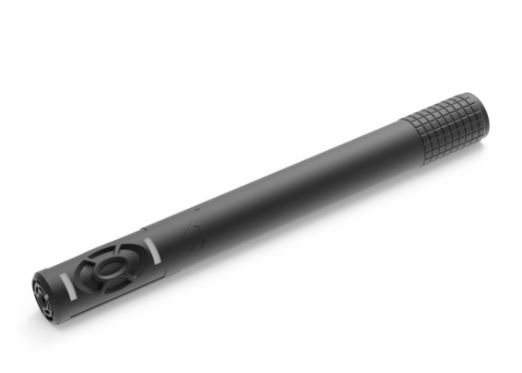
"Sound intensity" refers to the energy flow in space, i.e., the amount of energy transmitted through the normal direction of a unit area per unit time as radiated sound. Unlike sound pressure level, sound intensity is a vector that has both magnitude and direction. Therefore, sound intensity is suitable for sound source localization.
Physically, sound intensity is "energy per unit time and area", which is the same as "power per unit area", and is measured in watts per square meter (W/m²). Sound intensity can be calculated from sound pressure p and sound particle velocity u. To measure the parameters required for calculation, two types of sensors are available:
The first type is the PU probe produced by Microflown technology, which measures sound pressure p and direct sound particle velocity u. The velocity sensor consists of two very fine wires placed close to each other, which are heated by an electric current. To measure the sound pressure level, a microphone is integrated into the probe.
The other type is the pressure gradient sensor, also known as the PP probe, where the sound pressure p is measured by two microphones installed at two different positions close to each other in the sound field. The two microphones of the PP probe are mounted opposite each other and separated by a spacer. The length of this spacer affects the frequency range that can be measured: the shorter the spacer, the higher the upper frequency limit; the longer the spacer, the lower the lower frequency limit.
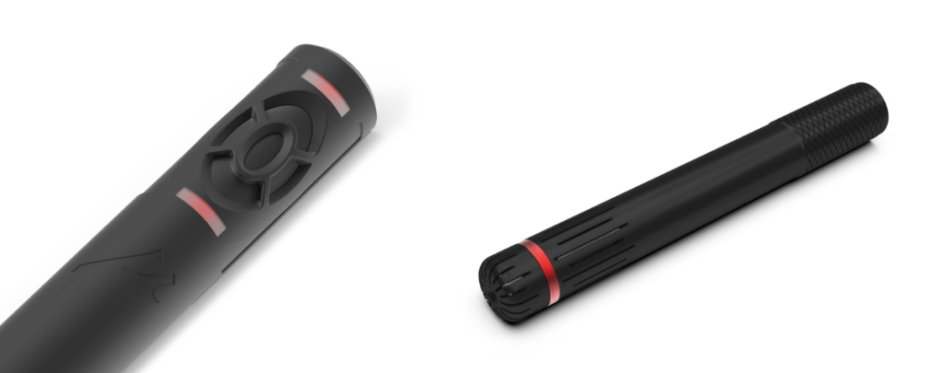
The standard 1/2-inch PU is a probe that combines two sensors: a traditional microphone and an acoustic particle velocity channel. Any sound field is defined by two complementary acoustic properties: the scalar value "sound pressure" and the vector value "particle velocity". In the acoustic near-field, sound wave particle velocity is a dominant acoustic characteristic. Microflown is a sensor that can physically measure sound wave particle velocity directly.
The PU probe can be used in a variety of applications, such as the measurement of sound intensity, sound power, sound absorption, and sound leakage determination. A key advantage of its measurement principle is that measurements can be performed in-situ under real-world conditions. The sensor is suitable for use under reverberant conditions and can be used in enclosed cavities, such as automotive interiors. Unlike microphones, the sensor does not have the problem of P/I (Pressure over Intensity) index and can suppress background noise and reflections by up to 40dB.
The standard configuration of the PU probe includes a 2-channel signal conditioner (MFPA-2) and the necessary wiring.



 Please leave your contact information, and we will get back to you as soon as possible!