






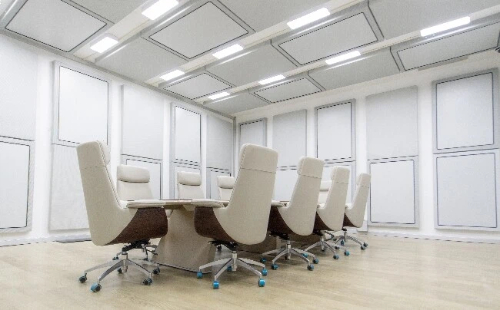
The key acoustic technical indicators for listening rooms and recording studios include reverberation time and sound field uniformity. Meanwhile, the background noise shall be controlled within an appropriate range to meet regular operation requirements.
For conventional listening
rooms, only the mid-frequency reverberation time needs to meet specified
criteria during design. High-performance listening studios impose strict
requirements on the frequency characteristics of reverberation time, which
should be kept as flat as possible. The sound absorption coefficient curves of
ordinary sound-absorbing materials or structures vary drastically with
frequency, especially exhibiting weak absorption at low frequencies. In
addition, listening rooms and recording studios are typically small acoustic
spaces, so the control of room acoustic modes is critical. Accordingly, various
types of sound-absorbing structures are required for listening rooms and
recording studios to adjust reverberation time across different frequency
bands. Low-frequency traps are a widely adopted low-frequency absorption
solution.
Furthermore, research demands
of modern artificial intelligence and multimedia technologies require listening
rooms to feature adjustable reverberation time, so as to evaluate product
performance under diverse real environments (e.g., communication headsets and
vehicle cabin acoustic quality).
During the design and
construction of listening rooms and recording studios, we have independently
developed multiple sound-absorbing structures including W100, FAA, FLA and EVA
to satisfy precise reverberation time frequency response and adjustable reverberation
performance requirements.
FAA Flip Adjustable Absorber
The FAA is an open-and-close
absorptive structure composed of two basic units. When unfolded, its top
surface acts as the sound-absorbing surface, while the side and back surfaces
function as reflective surfaces. When folded, all top, bottom and side surfaces
become reflective. The two FAA units are connected by hinges; rotating one unit
over the other via the hinge switches the absorber from unfolded to folded
state, forming an entirely reflective outer surface.
The sound absorption
performance of FAA varies with its absorptive area in open/closed states. By
adjusting the number of FAA units opened or closed inside an acoustic space,
the reverberation time of the space can be regulated.
The FAA has a base thickness
of 100 mm when unfolded, with perforated protective panels on the surface and
eco-friendly sound-absorbing filling inside. Thus, the unfolded FAA delivers
sound absorption performance comparable to the W100 structure. Even in folded
state, its reflective outer housing retains limited low-frequency absorption
capacity. Optimizing the material parameters of the outer shell suppresses room
acoustic modes and improves low-frequency acoustic performance of the space.
FLA Flip Low-Frequency
Absorber
The FLA adopts an
open-and-close structure similar to FAA, dedicated to low-frequency sound
absorption below 100 Hz. Each FLA basic unit consists of four resonant
absorbers, realizing effective sound absorption within the 60 Hz–100 Hz
frequency band.
Toggling the FLA between open
and closed states adjusts low-frequency absorption performance under 100 Hz.
When used in conjunction with FAA, the FLA further expands the adjustable
frequency range of flip-type absorbers and modifies the low-frequency modal
characteristics of the room.
The FLA features a base
thickness of 100 mm, with multiple configurable combinations of internal
resonant absorbers whose parameters are customized according to on-site space
conditions.
EVA Electric Variable Absorber
The EVA is an electrically
driven automatically adjustable sound-absorbing structure. Its surface adopts
slotted construction, consisting of fixed outer slotted panels and internally
motorized adjustable plates. The slit width can be continuously adjusted from 0
mm to 50 mm, enabling continuous modulation of sound absorption performance.
The EVA has a base thickness
of 200 mm, comprising electric drive mechanisms and sound-absorbing materials
inside. The driving components of each EVA unit can be interconnected and
controlled uniformly via a PID control panel.
Listening rooms and recording
studios generally belong to small acoustic enclosures, where room geometric
dimensions exert a profound influence on the internal sound field. In our
listening room design, we optimize room geometry based on room acoustic principles,
and deploy the aforementioned low-frequency absorbers to suppress low-frequency
modes, delivering optimal subjective listening experience.


 Please leave your contact information, and we will get back to you as soon as possible!